Vending machine software development cost depends on software architecture, features, hardware compatibility, and system integrations. From basic touchscreen applications to cloud-based management platforms, development requirements vary by business needs.
Off-the-shelf vending software typically costs $2 to $10 per device per month, while custom software development ranges from $3,000 to $10,000. Enterprise solutions require project-based pricing.
This guide covers vending software development costs, key pricing factors, development timelines, and ongoing expenses.
How Much Does Vending Machine Software Development Cost?
The cost of developing vending machine software depends on whether a business selects an off-the-shelf platform or commissions custom software engineering.
Off-the-shelf systems typically follow subscription-based licensing, while custom software development involves engineering costs determined by project requirements.
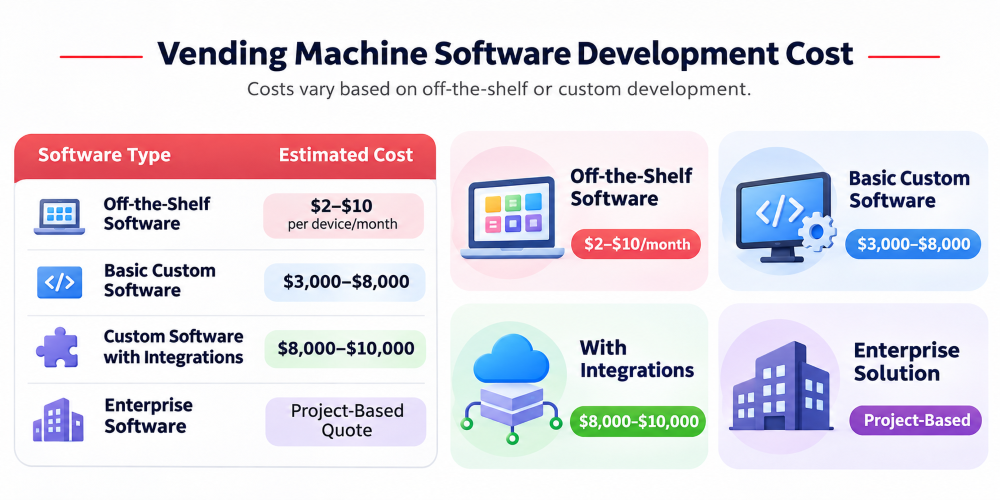
The following table provides indicative budget ranges for different vending software solutions.
| Vending Machine Software Type | Estimated Cost |
| Off-the-Shelf Vending Machine Software | $2–$10 per device/month |
| Basic Custom Vending Machine Software | $3,000–$8,000 |
| Custom Vending Machine Software with Integrations | $8,000–$10,000 |
| Enterprise Vending Machine Software Solutions | Project-Based Quote |
Note: These are illustrative planning estimates, not verified industry-wide averages or guaranteed vendor prices. Custom software ranges assume a limited, clearly defined development scope and compatible existing hardware. Hardware purchases, payment terminal certification, infrastructure charges, and extensive integrations may require additional budgets.
1. Off-the-Shelf Vending Machine Software – $2 to $10 Per Device/Month
Off-the-shelf vending software offers predefined functionality through subscription-based licensing. It is suitable for businesses using compatible vending machines with standard operational requirements.
Key Features:
- Inventory and transaction management
- Preconfigured reporting dashboard
- Basic machine status monitoring
- Subscription-based device licensing
The estimated monthly cost ranges from $2 to $10 per device. Pricing may vary depending on the software provider, licensing terms, and additional services.
2. Basic Custom Vending Machine Software – $3,000 to $8,000
Basic custom vending software provides essential functionality for a single machine or small deployment. It includes a customer-facing application and backend services for managing transactions.
Key Features:
- Touchscreen user interface
- Product and pricing management
- Basic payment integration
- Transaction history
This pricing generally assumes compatibility with an existing vending controller interface. Additional hardware customization may increase development costs.
3. Custom Vending Machine Software with Integrations – $8,000 to $10,000
Integrated vending software connects machines with cloud services and external systems, enabling centralized monitoring and operational management.
Key Features:
- Vending controller integration
- Third-party API integration
- Cloud-based management dashboard
- Real-time inventory synchronization
- Remote machine monitoring
These solutions typically use REST APIs, cloud databases, and asynchronous data synchronization. Costs may increase with complex hardware integrations or additional customization.
4. Enterprise Vending Machine Software Solutions – Project-Based Quote
Enterprise vending software supports large-scale deployments with advanced architecture, automation, and system integrations.
Key Features:
- Multi-tenant software architecture
- AI-powered demand forecasting
- Predictive maintenance
- ERP and CRM integrations
- Advanced role-based access control
- Enterprise-level scalability
Enterprise development costs depend on system complexity, integration requirements, infrastructure specifications, and deployment scale.
What Factors Affect Vending Machine Software Development Costs?
Vending software development costs are influenced by several engineering decisions. Understanding these factors helps businesses estimate the work required before development begins.
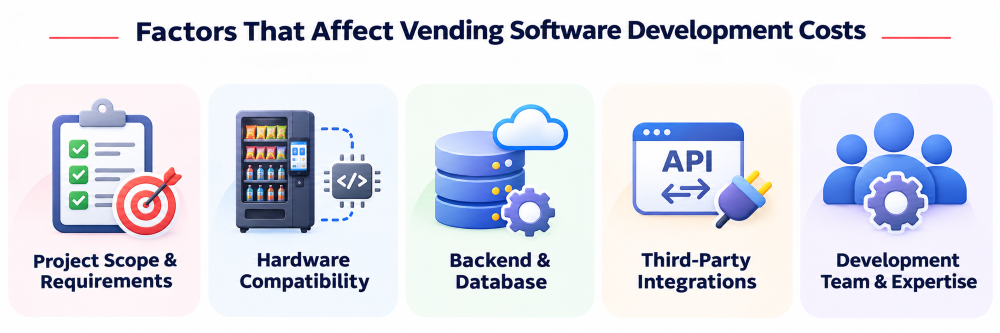
1. Project Scope and Technical Requirements
The software requirements specification (SRS) defines application functionality, system behavior, integrations, and acceptance criteria. A clearly defined scope helps developers estimate engineering hours and identify technical dependencies.
Key requirements include:
- Functional and non-functional requirements
- User roles and access permissions
- API and third-party integration specifications
- System performance and scalability requirements
- Software testing and acceptance criteria
Frequent changes in project requirements can increase development time, code modifications, and testing costs. Proper documentation helps minimize rework and maintain budget control.
2. Hardware Compatibility and Communication Protocols
Hardware compatibility directly affects vending machine software development costs. Different machines use specific controller interfaces, peripheral configurations, and communication protocols.
Common technical considerations include:
- MDB/ICP communication protocols
- DEX and EVA-DTS data exchange
- Serial communication interfaces
- Vending controller protocol adapters
- Communication error handling and recovery
Supporting multiple hardware manufacturers or proprietary protocols requires additional integration development, compatibility testing, and debugging, which can increase overall costs.
3. Backend Architecture and Database Design
Backend architecture determines how a vending application processes requests, stores transactions, and manages communication with connected systems.
A typical implementation may use:
- RESTful APIs for application-to-server communication
- Relational databases such as PostgreSQL, MySQL, or SQL Server
- Authentication and authorization services
- Background workers for asynchronous processing
- Message queues for reliable event delivery
Development costs depend on expected transaction volume, data consistency requirements, offline synchronization, and application reliability.
For smaller systems, a modular monolithic architecture may be sufficient. Larger deployments may justify more specialized services, but microservices are not automatically necessary.
4. Third-Party Integration Complexity
Third-party integrations affect vending machine software development costs by requiring secure data exchange between external platforms and backend systems.
Integration complexity depends on API documentation, SDK compatibility, authentication requirements, and testing environments.
Key technical considerations include:
- REST API and SDK integration
- OAuth authentication and API security
- Webhook processing and validation
- API rate limiting and error handling
- Payment authorization and transaction reconciliation
- PCI DSS compliance requirements
Complex integrations may require additional development, debugging, and security testing, increasing overall project costs.
5. Development Team Size and Expertise
The development team’s size, technical expertise, and hourly rates directly influence vending machine software development costs.
A typical development team may include:
- Frontend developers
- Backend developers
- UI/UX designers
- QA and software testing engineers
- Hardware integration engineers
- DevOps and cloud infrastructure specialists
Development costs vary based on team location, experience, and project complexity. Hiring engineers experienced in vending protocols, payment systems, and cloud architecture can reduce integration issues and unnecessary development expenses.
How Long Does It Take to Develop Vending Machine Software?
The vending machine software development timeline depends on system requirements, application complexity, and hardware integration work.
A basic project with a compatible controller may take several weeks, while a platform involving multiple integrations and custom infrastructure can require several months.
The following table illustrates typical development activities.
| Development Phase | Estimated Duration |
| Requirements Analysis and Planning | 1–3 Days |
| UI/UX Design and Prototyping | 2–4 Days |
| Frontend and Backend Development | 1–2 Weeks |
| Hardware Integration and System Testing | 3–5 Days |
| Deployment and Production Validation | 1–2 Days |
These are indicative phase estimates. Activities may overlap, and total delivery time will depend on project complexity and hardware availability.
1. Requirements Analysis and Planning
The development team evaluates business requirements, controller specifications, payment infrastructure, and software dependencies.
The outcome typically includes an SRS document, technical architecture, API requirements, and an initial implementation plan.
2. UI/UX Design and Prototyping
Designers create the customer-facing application flow, interface components, and interactive prototypes.
Usability considerations include touchscreen navigation, accessibility, transaction feedback, and error-state handling.
3. Frontend and Backend Development
Engineers implement the application interface, business logic, database schema, and required APIs.
This phase also involves authentication, transaction processing, and integration with selected services.
4. Hardware Integration and System Testing
Developers validate communication with vending machine controllers and connected peripherals.
Testing should cover successful dispensing, payment failures, communication timeouts, machine errors, and transaction recovery.
Integration testing is especially important because successful payment authorization does not always guarantee successful product dispensing.
5. Deployment and Production Validation
The final phase includes configuring production environments, deploying application builds, and validating critical workflows.
Developers verify API connectivity, transaction persistence, device communication, and system behavior before deployment is considered complete.
Why Choose Linkitsoft for Vending Machine Software Development?
Developing reliable vending machine software requires expertise in application development, backend architecture, hardware communication, and payment system integration.
Linkitsoft provides custom vending machine software development solutions tailored to business requirements, hardware specifications, and operational needs.
Custom Vending Software Development
We develop touchscreen applications, backend APIs, and administrative dashboards with scalable software architecture.
Hardware and Payment System Integration
Our team integrates vending machine controllers, payment gateways, and third-party APIs to support secure transactions and reliable machine communication.
Cloud-Based Vending Management Solutions
We build cloud-connected platforms for centralized machine monitoring, inventory synchronization, transaction management, and operational reporting.
Free Software Maintenance and Technical Support
We provide free software maintenance and technical support to ensure application stability, resolve technical issues, and maintain smooth vending operations.