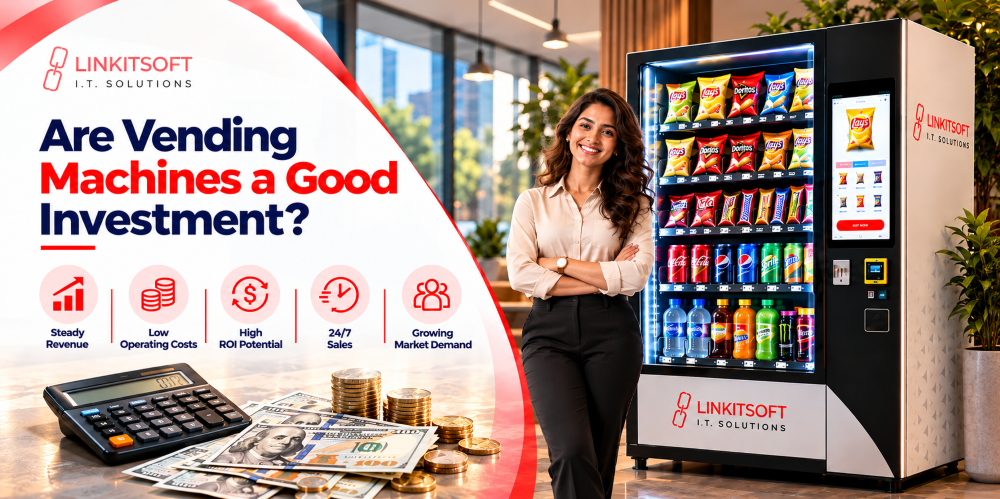
Vending machines look like an easy way to make money. Put one somewhere busy, stock it, and let it sell. But buying a machine doesn’t guarantee a profit. Location, demand, running costs, and how well you manage the thing all decide whether you end up ahead.
Here’s what to weigh before you put money down.
How Does a Vending Machine Business Generate Revenue?
A machine earns by selling products straight to customers. Snacks, drinks, personal care items, whatever suits the spot. Every sale brings in revenue, but what’s left after expenses is what tells you if the business is worth running.
Foot traffic matters, though what people do when they walk past matters more. A machine in an office with a cafeteria next door might sell very little despite all the visitors. A smaller one in a busy waiting area could do better, because people there actually need a drink and have few other choices.
Product choice and pricing play in too. Items that fit what customers want and feel fair on price sell better. You also need prices that cover what you paid for the product and leave room for everything else.
Volume changes the picture as well. Selling 20 items a day is a different business from selling 60, especially when you’re paying fixed costs like rent or software. You’re not after sales for their own sake. You want a setup where the sales leave you a decent return.
How Much Does It Cost to Invest in Vending Machines?
It depends on the equipment and where you plan to run it. A basic used machine can start cheaply. A new one with cashless payments, refrigeration, or remote monitoring costs a lot more. And the machine’s price is only one line in the budget.
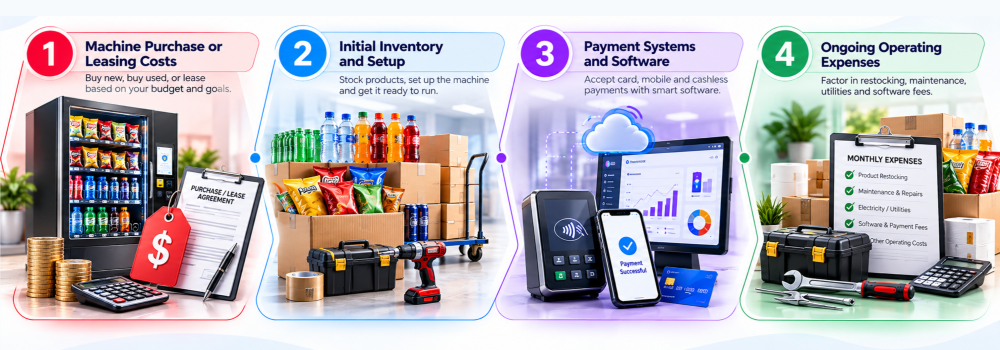
Machine Purchase or Leasing Costs
Buying outright means you own the machine with no lease payment over you. You can go new with the features that are modern or even used for less money.
Used machines are a fair way to start, but condition matters. A low price saves little if the machine needs constant repairs, has outdated payment hardware, or can’t run the software you want. Before you buy, check the dispensing mechanism and the refrigeration, if it has any. You also need to make sure the payment system works fine and whether replacement parts are easy to find.
New machines tend to bring current hardware and often also come with a warranty, though terms vary by supplier. They also make sense when you need specific features or your location has particular requirements.
Leasing cuts the money you need upfront, but you’ll have recurring payments and possibly contract limits. Compare the total lease cost with the purchase price, including any maintenance or fees built into the deal. There’s no single right machine. It comes down to budget and expected demand.
Initial Inventory and Setup
Once the machine’s yours, it needs products. What you spend depends on its capacity, how many varieties you stock, and how much you want on hand before the first restock.
Filling every slot straight away is tempting, but it isn’t always smart. If you’re testing a new location, a sensible starting range shows you what people really buy before you tie up too much cash in stock.
Count transport and installation too. A big machine may need professional delivery and the right power supply. Refrigerated units can have extra placement and running requirements.
Location costs deserve a look. Some property owners charge a flat rent, others take a cut of sales, and some want a deposit. Any of these changes how much you need before the machine earns a cent.
Payment Systems and Software
Payment options affect both setup and running costs. A cash machine may need coin and note handling equipment. Cashless payments need a compatible card reader or reliable terminal.
Cashless can bring hardware costs, and sometimes monthly service charges, depending on the provider and your agreement. Check those numbers before deciding if a given system makes sense.
Vending software is another possible cost. With one machine, you can often manage without it. As you grow, software that tracks sales, stock, machine status, and restocking can save real time. Some platforms charge a subscription, others bundle the software with equipment or payment services, and cellular data may add its own fee.
Weigh these costs against the work they save. A monthly fee is worth it if it prevents wasted trips or flags stock problems early. For a single machine with few sales, the same fee can be hard to justify.
Ongoing Operating Expenses
The costs don’t stop once the machine is installed. You replace stock, maintain the equipment, and travel to the location when needed. Build these into your calculation from the start.
Product inventory is usually the main ongoing cost. You buy replacements as items sell, and the gap between what you pay and what you charge makes up your gross profit.
The rest includes repairs, cleaning, transport, electricity where it applies, payment processing, software, and location commissions. Some machines also need replacement parts or specialist servicing now and then.
Travel is easy to underestimate. With machines in several places, the time and fuel for restocking can eat into returns. A machine that sells well but needs constant visits can be less attractive than one with slightly lower sales and much easier upkeep.
How Profitable Is a Vending Machine Business?
Revenue tells you how much customers spent. It doesn’t tell you how much you keep.
Say a machine takes $1,500 in a month. If the products sold cost you $650, you have $850 in gross profit before other expenses. Then location fees, payment charges, transport, repairs, software, and other costs come out of that.
Here’s a simplified example of how it might look.
| Monthly figures | Illustrative amount |
| Sales revenue | $1,500 |
| Product costs | $650 |
| Gross profit | $850 |
| Location commission | $150 |
| Payment processing fees | $45 |
| Transport and maintenance | $100 |
| Software and connectivity | $35 |
| Net operating profit | $520 |
That’s $520 in monthly operating profit, about 34.7% of sales, before any expenses not listed. These numbers are for illustration only, not a guide to typical earnings. Real results can be much lower or higher.
It also shows why strong sales don’t always mean strong profit. If a machine needs expensive stock, high commissions, or frequent service visits, those costs can swallow most of the revenue.
Your initial investment matters too. If you spent $3,000 on the machine and setup, you’d compare that with the profit it produces over time to estimate when you get your money back. A machine with steady profit usually recovers its cost sooner than one with uneven sales, but your actual results depend on how the business performs.
The most useful calculation uses your own expected costs and realistic sales. Estimate how many items you can sell, the margin on each, and everything it takes to keep the machine running. That tells you far more than broad claims about what vending machines earn.
What Factors Determine Whether Vending Machines Are a Good Investment?
Two machines can look nearly identical and perform very differently. The gap usually comes from placement, products, and how much work the machine demands.
Location and Customer Demand
Location decides who sees the machine and whether they have a reason to buy. A busy place isn’t automatically a profitable one.
Compare a crowded corridor where people hurry to their next stop with an office break area where employees spend a few minutes between tasks. Both get plenty of foot traffic, but the break area gives people time and reason to buy.
Think about what customers need while they’re there. Office staff want snacks and drinks during the day. Gym visitors look for water or protein snacks. Travellers value easy refreshments, and people waiting for appointments appreciate a simple choice of drinks and packaged food.
Opening hours count as well. A machine in a building that closes early has limited selling time, while one in a place with evening or overnight activity can serve customers for longer.
Before you commit, learn who the audience is, what their routine looks like, what’s already available nearby, and when demand peaks. A good location is one where customer needs and your product range line up.
Product Selection and Pricing
Even a well placed machine struggles when the products don’t suit the people using it. Stocking something just because it sells elsewhere isn’t a reliable plan.
An office machine might do better with coffee, bottled water, and familiar snacks, while a gym machine needs a different mix. The right selection depends on local tastes, spending habits, and what else is nearby.
Pricing is a balancing act. You need to cover product costs and running expenses while staying reasonable for customers. Price too low and each sale earns little. Price too high and people walk to the shop instead.
Shelf life matters as well. Perishable items can attract buyers but create waste if demand is patchy.
Packaged goods with longer shelf lives are easier to manage while sales are still unpredictable. Start with products that make sense for the spot, then let sales records guide changes. You won’t get the mix perfect on day one, but you do need to watch what customers actually buy.
Competition and Location Agreements
Nearby alternatives affect how a machine performs. If customers can buy the same thing from a shop a few steps away, they might choose it for the wider range or lower price.
That doesn’t rule out success near other businesses. Convenience still wins sometimes. People may prefer a machine that’s open late, closer to their desk, or quicker than a queue.
The agreement with the property owner matters just as much. A flat fee is a regular cost even in quiet months. A commission moves with sales, but a high percentage cuts into what you keep on every transaction.
Read the terms before you install anything. Check how payment works, how long the contract runs, whether you can get in to restock, who covers electricity, and whether there are limits on what you can sell. Also ask what happens if the spot underperforms and you want to move the machine. A promising location can turn into a poor investment if the agreement leaves too little room for profit.
Restocking and Maintenance Requirements
Vending machines need regular attention. You refill products, pull out expired items, check payment systems, and fix mechanical problems.
Stockouts are a common trap. If popular items sell out before your next visit, you lose sales and may disappoint regulars. Carrying too much stock ties up cash and causes waste, especially with shorter shelf lives.
Maintenance works the same way. A machine that stops dispensing or can’t take payments loses sales until someone fixes it. If it sits far from your usual route, even a small fault can get expensive.
Think about time as well as cost. A machine that needs frequent visits can be less convenient than its sales suggest. Grouping nearby machines into one restocking route cuts travel time and expense. The aim is to keep machines stocked and working without spending more on visits and repairs than the location can support.
How Can You Improve the Return on Your Vending Machine Investment?
Better returns don’t always mean buying another machine or raising prices. Often you get more by making the equipment you own work harder.
Track what sells. Look at sales by product and location to see which items move steadily and which just take up space. Swap out weak performers when you have a good replacement, but give new products enough time to produce useful data.
Watch the gap between selling price and product cost. A fast seller can still add little profit if the margin is thin, so compare both volume and what each product contributes after its cost.
Plan restocking around actual demand rather than one schedule for every machine. A busy spot might need frequent refills while a quiet one doesn’t. If you run several machines close together, line up visits so one trip covers more than one location.
Finally, look at the full cost of running each machine. Payment fees, subscriptions, repairs, transport, and commissions are easy to overlook when you stare at sales. Small savings across those lines can raise what you keep without needing much more revenue.
How Does Vending Machine Software Help Manage Investment Returns?
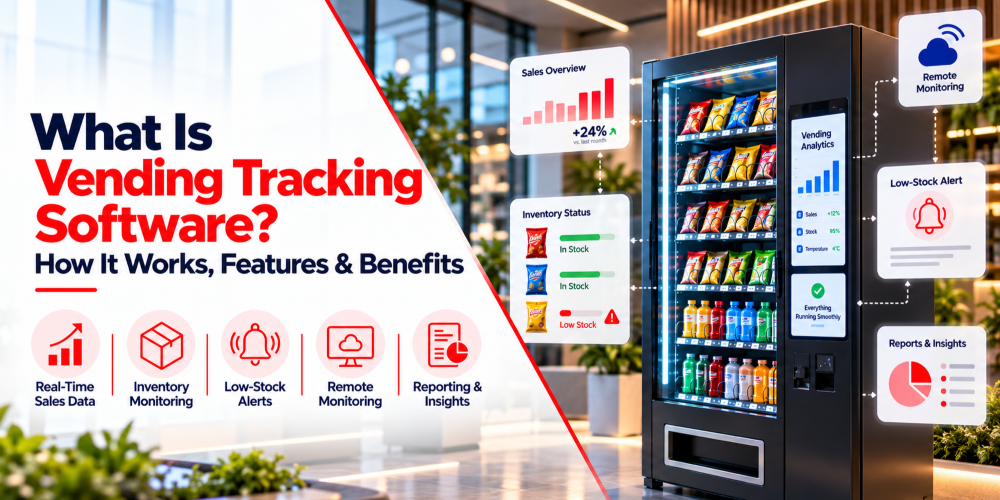
Once you run more than one machine, tracking every sale, stock level, and maintenance issue gets hard. Vending software pulls much of that together so you can see how each machine is doing and where money might be leaking.
Sales Reports and Performance Tracking
Sales reports show which products sell, when demand rises, and how revenue differs between locations. That helps you decide what to stock and whether a machine is meeting expectations. You can also compare sales with operating costs for a clearer view of each machine’s contribution.
Inventory Tracking and Restocking
Inventory tracking helps you plan restocking visits. Depending on the hardware and software, the system might record items sold, estimate remaining stock, or collect readings from sensors. Low stock alerts help prevent popular items from selling out before you arrive.
Remote Monitoring and Fault Detection
Remote monitoring is useful when something goes wrong. If the system reports a disconnected payment terminal or a machine fault, you can investigate before driving out. That can save unnecessary trips, though some problems still need a physical inspection.
Comparing Costs and Returns Across Machines
The biggest benefit is having a clearer picture of the whole operation. Instead of treating every machine the same, you can see which locations need more stock, which products are worth keeping, and which machines may need a different approach.
Software does cost money, and not everyone needs an advanced platform. With one basic machine, a simple record of sales and expenses may be enough. As the number of machines grows, central reporting and monitoring become more valuable.
Should You Buy One Vending Machine or Build a Fleet?
Starting with one machine, or a handful, lets you learn the business without committing a big sum. You can test a location, see what customers buy, get a feel for the restocking routine, and spot surprise expenses before expanding.
That’s especially useful if you’ve never run vending machines. The first few months reveal things that are hard to predict on paper, like which products sell slowly, how often the machine needs attention, and whether the location agreement leaves enough room for profit.
A bigger fleet brings more revenue potential and more responsibility. You manage more inventory, coordinate restocking, keep equipment working, and compare locations. Buying more machines before you understand your costs can multiply problems instead of profit.
Efficiencies do appear as you grow. Several machines in one area are easier to service on one route, and central software simplifies reporting and monitoring. You may also negotiate better supplier terms as your orders increase, depending on your suppliers.
A sensible path is to expand once your current machines perform consistently and you have a clear plan for handling more locations. Look at the real profit and workload of what you have before deciding how many to add.